We Need a Science Liberties Foundation
An experiment in letting scientists experiment.
This essay is also cross-posted on my Substack. It is not legal advice; only general information. Circumstances and jurisdictions vary.
The first open-source passive radar project ended before it even began.
In November 2022, KrakenSDR announced that it was removing all passive radar code from its software-defined radio device, despite months of effort and anticipation from the amateur radio community. The team explained in a tweet:
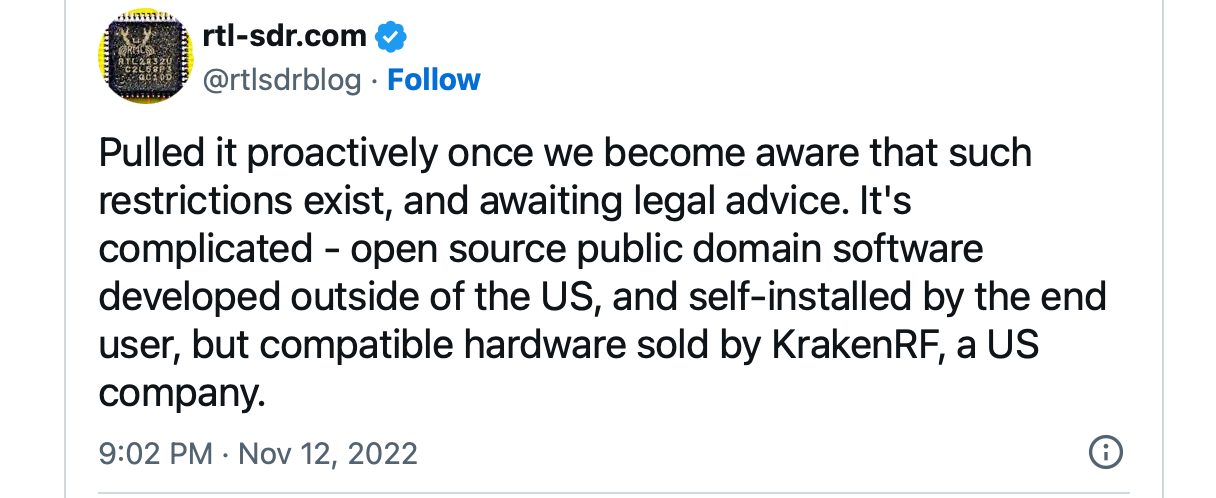
It was another casualty of ITAR, the International Traffic in Arms Regulations that restricts the "export" of "defense articles." Like many regulations, though it sounds reasonable, this entirely depends on definitions. Here “export” includes “releasing or otherwise transferring technical data to a foreign person in the United States,” and “defense articles” is anything on the United States Munitions List.
Passive radar is considered a "munition," along with a laundry list of other technologies, making it illegal for a non-American to see code, schematics, or physical parts.
KrakenSDR’s passive radar was DOA.
Why Passive Radar
My introduction to ITAR came in early 2025, when I became obsessed with an idea. What if just by listening to the radio, you could sense anything on the Earth's surface, up to the stratosphere, and beyond? This is passive radar, which works by listening for radio echoes that bounce off objects from broadcast sources such as TV and FM towers.
These signals are everywhere, and by comparing the echo to the direct signal, you can map everything they've reflected off of. In 2005, P.E. Howland developed a system for NATO that detected planes out to 100+ miles using FM radio, using a cluster of six Pentium 4's for signal processing. However, the need for expensive hardware was temporary, as consumer technology was about to undergo a revolution.
In 2007, the iPhone was released, and by the 2020s, over 10 billion smartphones were made, each with a microprocessor. In 2023, benefiting from the cost and performance gains enabled by this level of production, the Raspberry Pi 5 single-board computer was released. It featured a quad-core ARM smartphone processor that was 2-3x faster than Howland’s 2005 cluster of Pentium 4's for radar workloads.
For less than a hundred dollars, all the necessary compute was available in a package the size of a bar of soap. By spring of 2025, I had realized this and updated the open-source radar package Blah2 to work on a Raspberry Pi.
With such low deployment costs, a global passive radar network would finally be possible, just as long as nothing else got in the way.
ITAR Intervenes
I had heard about ITAR before I started building my kits, but I wasn't yet sure that the system could work, so I put off dealing with it until I made more technical progress.
Once it started to look like I was getting somewhere, though, I asked the Open Research Institute for help. They had dealt with similar issues with their satellite work and were familiar with the KrakenSDR case. They gave me helpful advice and also mentioned another entirely separate radar project that ended due to ITAR risk.
And I understand why they stopped. It seems risky; whenever I explain the situation to someone, they gasp at the words "arms" and "traffic" and try to talk me out of it before I even get to "federal prison."
Bernstein vs. The United States
In 1997, mathematician Daniel J. Bernstein was in the same situation as me. Except that instead of passive radar, it was cryptography over 40 bits that the US considered a munition.
In Bernstein vs. The United States, he challenged the requirement that he register as an arms dealer, resulting in the precedent that code was free expression under the First Amendment.
You would think that this should have settled ITAR restrictions on dissemination as unconstitutional, but because ITAR was never actually struck down, it only covered that specific case. The State Department chose to loosen restrictions on cryptography in order to keep everything else. Now unrestricted, Bernstein no longer had standing to challenge ITAR, and when he pushed further, a judge "asked Bernstein to come back when the government made a 'concrete threat.'"
Strategic Ambiguity
The State Department plays this game. They tell people to waive their constitutional rights because of ITAR, take them to court, lose, and then grant a special exception just for them. Sometimes they have to pay you too.
However, because they granted a special exception for just this one case, ITAR is still available to scare everyone else.
If you ask the State Department, they will strongly imply that ITAR means you can't release any relevant technical data without their approval, though they can't make that explicit because that would be unconstitutional prior restraint. Instead, by keeping it ambiguous, ITAR stays up and continues to intimidate. I wish this were just my pet theory, but in fact, I discovered it in the oral arguments of yet another case the government lost.
A List of Casualties
I can't list them all here, because how do you count things that don't happen? Still, here's a sampling:
- Phil Zimmermann, inventor of PGP, was criminally investigated for three years for allegedly exporting cryptographic code. The case was dropped only after MIT Press published the source code as a book.
- U.S. astronomers barred from sharing satellite data with European co-investigators.
- Advanced materials firms avoiding DoD funding to prevent “ITAR taint,” shifting R&D abroad to keep products free from export controls.
- Non-U.S. persons are prohibited from even looking through Gen 3 night vision devices, limiting international collaboration in low-light field research.
- AI systems must avoid unintentionally generating ITAR-controlled technical data for foreign users, creating hard-to-detect export violations.
- 3D printing firms face sanctions for sharing CAD files internationally.
- Mid-tier universities simply avoid NASA-funded research altogether.
This doesn't even include my beloved passive radar, or all the times people lost and ended up in jail.
What the Solution Is Not
Currently, there are three approaches to dealing with the ITAR:
- Play it extremely safe, avoid anything plausibly ITAR-infringing, and follow your institution's risk-averse export control policy. This is how it's typically done in academia.
- Hire an army of lawyers, implement countermeasures, then litigate and settle as needed. This is how big companies manage it.
- Learn from public caselaw, take what steps you can (e.g. also publish a book of code), apply for small grants for legal defense, and generally just take the risk. Assume the government will eventually come after you, and make your life hell, but that you'll find support and beat the rap. This is how you exercise your constitutional right to open knowledge, while also having no money.
The last one you may recognize, because it's what I'm currently doing, but it’s not a generalizable solution. I don’t have a mortgage, young kids, or academic position to worry about. I’m in an unusually good position to take risks, so I am willing to develop passive radar, but you can't expect every scientist to take their life in their hands for the craft.
A Science Liberties Foundation
Civil rights has the ACLU, free speech has FIRE, and digital technology has the EFF.
Science needs its own civil liberties foundation. It might just be an ITAR liberties foundation because that's what's causing all the havoc. That could be a good thing, though, because there is a well-defined target.
There's plenty of research on the effects of ITAR on science, but it takes a literal act of Congress to change it. Still, we don't need Congress, because ITAR is already constrained by the highest law in the land.
However, in a common law system, a law can only be found unconstitutional when challenged in court, and that takes resources. Without backing, we researchers feel like a lone ant before the juggernaut of the state, even when we're right. Legal departments optimize for not getting prosecuted, rather than getting prosecuted and winning. Their advice will always be how to keep the State Department (unconstitutionally) happy.
If you do get prosecuted, sometimes a foundation will step in to save you. But currently, you can't walk in and get a guarantee of support before research starts, and no one wants to take the risk that the cavalry never arrives.
What to Build
The organizational model would be similar to FIRE, which provides direct representation in named cases and exerts public pressure, combined with the technical depth of EFF. Two million a year covers a staff lawyer, outside counsel for one active case, and an advisory board of export-control veterans.
The key is the ex ante letter. A researcher submits a project for review, and if the situation is straightforward (US person, civilian use, technical data released publicly), then the foundation issues a written commitment to defend any prosecution within that scope. A letter in hand breaks ITAR’s chilling effect.
Year one would start with incorporating a 501(c)(3), appointing the board, publishing a researcher's guide to ITAR (doubling as a recruiting document), filing an amicus brief in an existing case, and issuing the first ex ante letters.
Most meta-science problems are fuzzy and intractable, but this doesn’t require upending institutions or writing new law. It only asks that someone do the boring institutional work of standing up an organization, and that scientists be willing to walk through the open door.
(I’ll be first in line.)