Can Passive Radar Detect Stealth Aircraft?
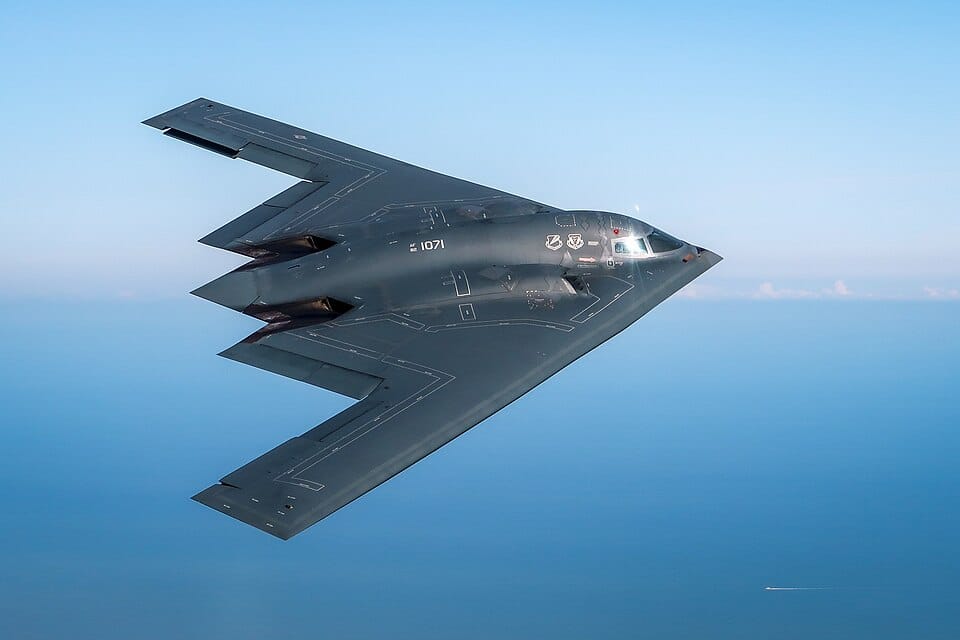
It's one of the most common questions in the radar world: Can passive radar see stealth? The short answer is yes, with caveats. The longer answer gets into physics and engineering tradeoffs that are worth understanding.
Stealthy Shapes
Stealth aircraft such as the F-22 or B-2 are designed to minimize their radar cross-section (RCS) against conventional "active" radar. Active radars have their own dedicated transmitters and are usually monostatic, meaning they transmit and receive from the same location. One of the ways these aircraft achieve stealth is by shaping, meaning angling their surfaces to deflect radar energy away from the transmitter.
However, with passive radar, which is radar that uses existing transmitters (FM radio, TV etc.) for illumination, the transmitter and receiver are in different locations, so reflecting radio waves away from the transmitter may very well be reflecting them towards the receiver.
Frequency Effects
When a radar wave hits an object, how it scatters depends on the relationship between wavelength and object size. There are three regimes:
- In the optical regime, the wavelength is much smaller than the object. A typical active radar uses X-band at ~3 cm wavelengths, so much smaller than a 15–20 meter aircraft. Here, radiowaves act like light on a mirror, and so they will reflect off angled surfaces.
- In the Rayleigh regime, the wavelength is much larger than the object, and rather than reflecting, it scatters in all directions.
- In between is the resonance regime, where the wavelength and the object are on roughly the same scale. The electromagnetic wave couples with the entire structure, like an antenna, and the scattering pattern becomes spiky and hard to suppress through shaping alone.
FM and DTV Passive Radar
FM radio and Digital TV broadcasts have wavelengths of about 1-3 meters, roughly on the order of a fighter aircraft 15–20 meters long and perhaps 10–13 meters in wingspan.
This puts the plane in a resonance regime where stealth's core adaptation, precise geometric shaping, is much less effective.
Radar-Absorbing Materials (RAM)
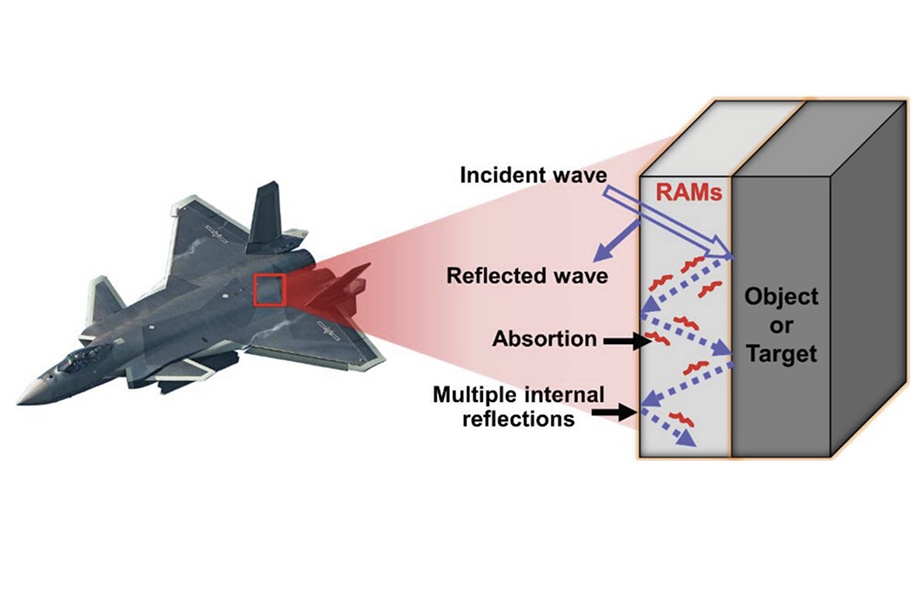
RAM works by converting electromagnetic energy into heat as the wave passes through the coating. The effectiveness depends on the coating being a meaningful fraction of the wavelength thick. At X-band (3 cm wavelength), a coating a few millimeters thick can absorb a significant fraction of the incident energy.
However, with long wavelengths, you'd need absorbing material on the order of tens of centimeters to achieve comparable absorption, which would be impractical for any aerodynamic aircraft.
What this means practically
The upshot is that an aircraft optimized to have a tiny radar cross-section at X-band might present an RCS that is orders of magnitude larger at VHF. The stealth shaping and coatings that make it nearly invisible to a conventional fire-control radar simply aren't effective against meter-wave illumination.
This is why VHF-band radars have always been part of counter-stealth measures. Soviet-era P-18 and its successors operate in this frequency range for exactly this reason.
Covertness Limits Countermeasures
One of passive radar's most underappreciated advantages is its inherent covertness. An active radar announces itself by broadcasting powerful electromagnetic pulses that electronic warfare (EW) systems on the aircraft can detect, characterize, and respond to. Stealth aircraft carry radar warning receivers (RWRs) that tell the pilot what type of radar is looking at them, from what direction, and how urgently they need to respond, enabling evasive action, jamming, or tailored countermeasures.
Passive radar breaks this entire chain at the first link: the receiver emits nothing; it's just an antenna and a processor, listening. The aircraft's RWR will pick up the FM or DTV broadcast signal, but those transmitters are everywhere and always on, so there's no way to distinguish "a signal that happens to be illuminating me" from "a signal someone is using to track me." You can't jam what you can't see, and you can't evade a threat you don't know is there.
So Does Passive Radar Defeat Stealth?
While it has its advantages, there are several tradeoffs that come with passive radar:
Resolution and tracking precision. Passive radar resolution depends heavily on the illuminator: a 6 MHz DVB-T digital television channel might achieve a resolution of ~100 meters. While this is useful for search, it's not sufficient for targeting, so active radars are usually used in combination with passive radars to definitively locate a target.
Signal processing complexity. Passive radar has to work with signals it doesn't control, so you can't optimize the waveform. You also have to perform direct-path interference cancellation to suppress the line-of-sight signal from the transmitter, which can be 60–80 dB stronger than the target echo. This computationally demanding work that imposes performance ceilings.
Illuminator dependence. Passive radar is reliant on illuminators of opportunity, so if the FM or TV station goes off-air, the radar goes blind. In a military scenario, an adversary could jam or disable civilian broadcast infrastructure. Also, the coverage geometry is dictated by where those transmitters happen to be, rather than optimal detection geometry. In remote areas, coverage may be absent entirely.
Detection vs. engagement. Even with a good detection, passive radar typically provides a "cue" rather than a "track". It can tell an air defense network that something is in a particular area, prompting other sensors to focus there, rather than being a standalone fire-control solution.
Real-world Examples
Several nations have developed operational or near-operational passive radar systems with counter-stealth as a motivating use case. The Czech VERA-NG and its predecessors are perhaps the most well-known, along with systems from Hensoldt (formerly Cassidian) in Germany, Thales in France, and various Chinese programs. These systems typically fuse returns from multiple illuminators and multiple receiver sites, using TDOA and Doppler analysis to triangulate targets. Multistatic configurations (many receivers spread over a wide area) increase the likelihood that at least some bistatic angles will capture favorable scattering from a stealth platform.

The bottom line
Passive radar offers a genuine, physics-based advantage against stealth aircraft through favorable bistatic geometry and low-frequency illumination. It is not a silver bullet. It trades the exquisite precision of conventional military radar for resilience, covertness (the receiver emits nothing), and the ability to exploit an Achilles' heel in how stealth shaping works. The most plausible role for passive radar in counter-stealth is as a cueing layer within a broader integrated air defense system.